Company News · WAE Media
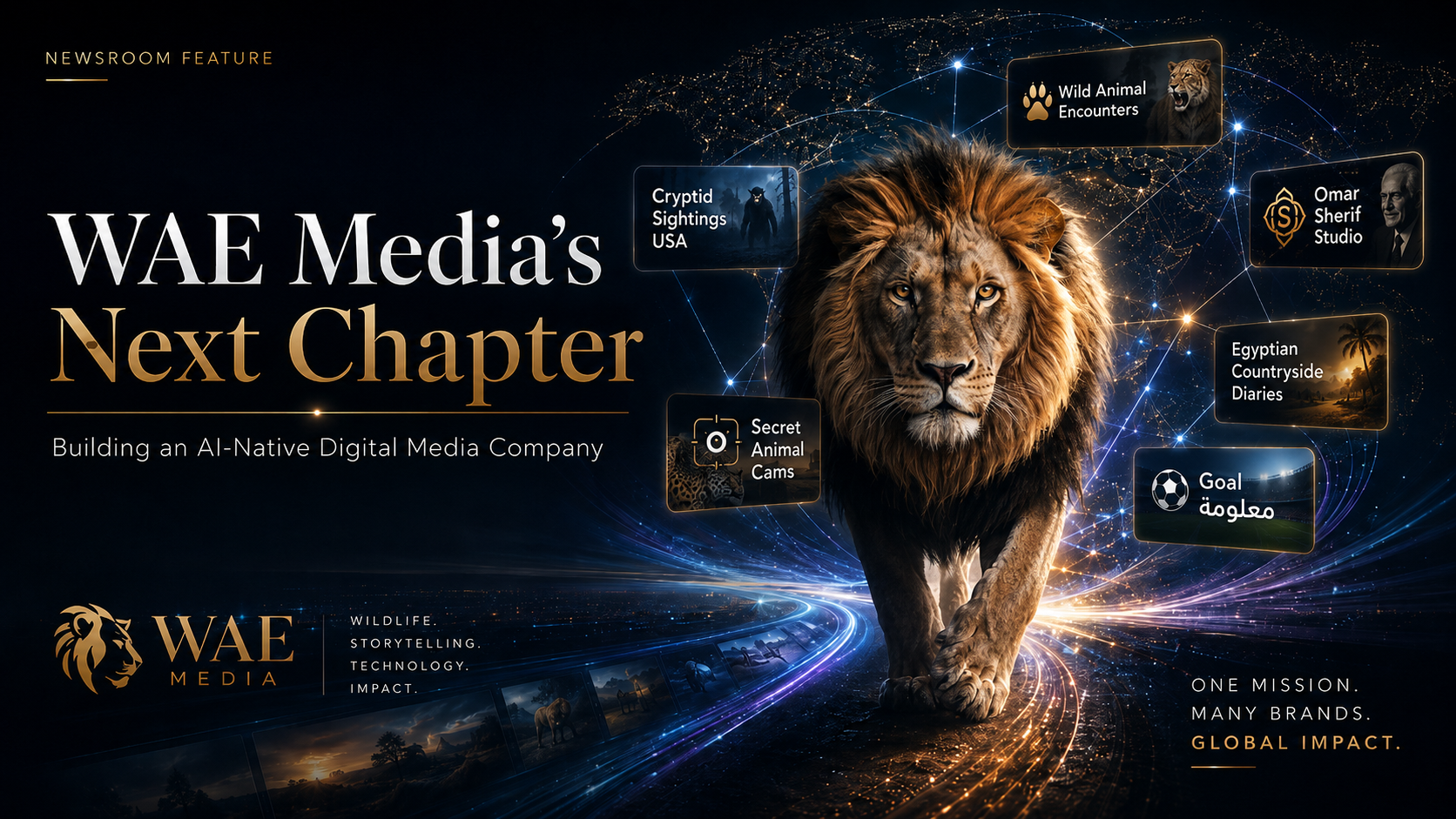
WAE Media's Next Chapter: Building an AI-Native Media Company After Half a Billion Views
An on-the-record account of WAE Media's first chapter, the strategic publishing pause that followed, and the AI-native, multi-brand media company being built next.
By WAE Media Editorial Team ·
Introduction
WAE Media, LLC is a multi-brand digital media company building cinematic, social-first entertainment for global audiences. In a remarkably short window, the company moved from launch to mainstream cultural visibility, demonstrating that emotionally driven, AI-assisted wildlife storytelling can compete at the highest tier of attention online. That early success is now the foundation for a deliberate next chapter: one in which WAE Media reorganises around stronger ownership, direct infrastructure, and an AI-native production model designed to scale across multiple original brands rather than depend on any single distribution surface.
This article documents that transition on the record. It is written in the voice of the company itself, for readers who care about how modern media businesses are actually built — the choices, the constraints, and the discipline required to convert viral momentum into a durable institution.
The Rise of Wild Animal Encounters
Wild Animal Encounters launched on November 18, 2025 as the flagship brand of WAE Media. Within days it became one of the most visible new wildlife storytelling properties on social media, reaching 827M+ documented views across Facebook and Instagram in under seven months (99.99% organic) and assembling a global audience drawn to the brand's signature blend of cinematic framing, emotional stakes, and high-craft AI-assisted production. A single Instagram Reel from the launch window crossed tens of millions of views inside its first twenty-four hours, a result that confirmed in public what the team had believed in private: there is a vast, underserved global appetite for wildlife content that is shot, lit, scored, and edited like cinema rather than like a clip reel.
That early traction matters because it answered the only question that ultimately decides whether a media company has a future. The question is not whether the team can produce. The question is whether audiences, given the choice, will reliably choose what the team produces. Wild Animal Encounters answered that question conclusively, and it answered it at a scale that very few independent media companies reach in their first year, let alone their first month.
Growth Under Pressure
Rapid scale brings a second set of problems that almost no first-time founder anticipates. As Wild Animal Encounters' library spread across the open internet, WAE Media encountered the structural realities of platform-dependent publishing at the upper end of the attention curve: content protection limitations on viral assets, unauthorised reposting and duplication of original work, monetisation instability, and distribution inconsistency that made publishing continuity harder to maintain than the underlying creative pipeline warranted.
These are not unique problems. They are the standard friction surface for any independent studio whose work performs well enough to be worth copying. They are also not, on their own, an indictment of any particular platform. They are a description of what it means to build original intellectual property on infrastructure that one does not own. The lesson WAE Media drew from that period is the lesson most serious media companies eventually draw: a single distribution surface cannot, by itself, be the foundation of a multi-brand business that intends to last.
A Company-Wide Publishing Pause
In response, WAE Media took a step that is rare in social-first media and almost unheard of in companies experiencing this kind of growth curve. Management implemented a strategic publishing pause across the company. The pause was deliberate, it was company-wide, and it was not limited to the flagship. Every brand under the WAE Media umbrella — Wild Animal Encounters, Cryptid Sightings USA, Secret Animal Cams, Egyptian Rural Diaries, Goal Maaloma, and Omar Sherif Studio — slowed external publishing while the company strengthened its underlying systems.
The pause was not caused by a lack of creativity, and it was not caused by a lack of demand. It was a management decision made to protect the company's media assets and to rebuild from a stronger position. Three workstreams ran in parallel during that window. The first focused on infrastructure: a stronger official website, a public newsroom, dedicated brand pages, structured SEO and machine-readable knowledge surfaces, and the public documentation a serious media company is expected to maintain. The second focused on ownership: a clearer organisation of original assets, a defined brand portfolio, a coherent intellectual-property posture, and an explicit creative direction across the company. The third focused on production: preparation for AI-native workflows, cinematic pipelines, and scalable multi-brand storytelling systems that can support several active brands concurrently without diluting the craft of any of them.
Platform Dependency Is Not Enough
The deepest lesson of the period was structural rather than tactical. Platform-dependent publishing, on its own, is a fragile foundation for original work. It rewards velocity over ownership, distribution over rights, and reach over the slower, more compounding economics of a brand that audiences seek out by name. For a single creator, that trade is often worth it. For a multi-brand media company that intends to operate for decades, it is not.
WAE Media's response is not to retreat from social platforms; on the contrary, the company will continue to publish at scale on every surface where its audiences live. The response is to add a layer the company controls directly. That layer includes an institutional website at wildanimalencounter.com, a public newsroom that lets the company speak in its own voice rather than only in fifteen-second cuts, a transparent brand portfolio, and machine-readable metadata that helps search engines and AI systems represent WAE Media accurately. None of this replaces the role of social distribution. It complements it, and it ensures that the company's identity, ownership posture, and creative direction are anchored in surfaces that the company itself owns and operates.
!Cinematic momentum — WAE Media's growth arc reframed as a journey, not a chart.
The AI-Native Direction
The forward strategy is best described in a single phrase: AI-native media. WAE Media is not adding AI as a post-production accelerator on top of a traditional studio model. The company is reorganising the entire creative pipeline — from concept to character to scene to score to localisation — around AI-native workflows, with human creative direction at every decision point that matters.
In practical terms this means cinematic AI storytelling treated as a primary craft rather than an experiment, original character-driven content that can sustain a brand across years rather than across a single trend cycle, multi-brand media development run on shared production infrastructure, multilingual content systems that allow the same story to land natively in English, Arabic, and other major audiences, and an explicit posture on original intellectual property so that the value created by the work accrues back to the company that produced it. Omar Sherif Studio, the company's dedicated cinematic AI label, will lead much of the long-form and original-IP work in this direction, while the audience-facing brands continue to operate at the social-first cadence their communities expect.
A Multi-Brand Future
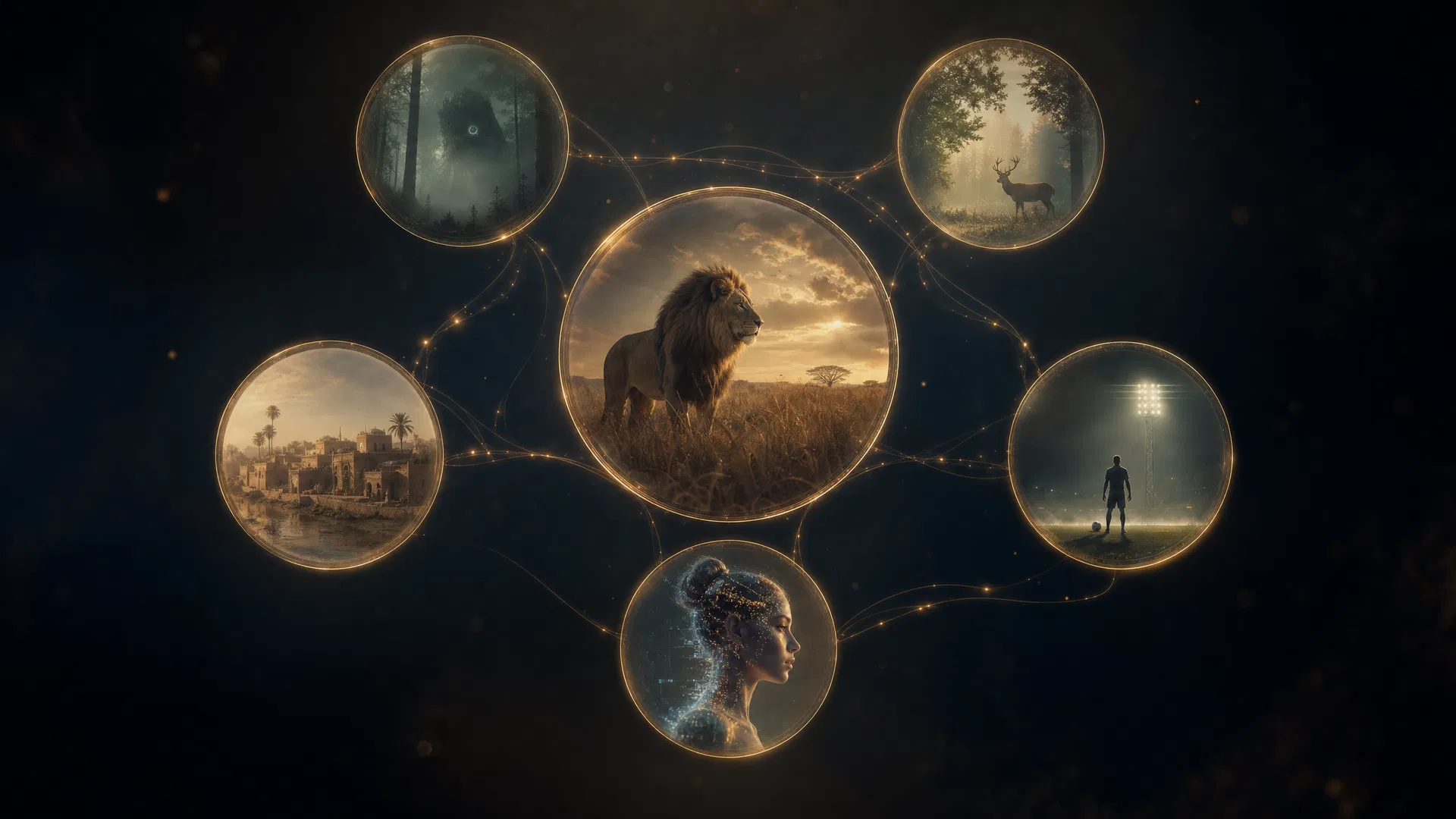
The portfolio is the point. WAE Media is not optimised to be a single viral channel; it is structured to be a coordinated set of original brands, each with its own audience, voice, and cinematic identity, sharing a common production layer underneath.
| Brand | Editorial Territory | |---|---| | Wild Animal Encounters | Global wildlife storytelling and viral animal encounters at cinematic quality. | | Cryptid Sightings USA | Mystery, cryptid, and unexplained-creature storytelling for an English-speaking audience. | | Secret Animal Cams | Hidden-camera-style animal content and patient wildlife discovery. | | Egyptian Rural Diaries | Arabic rural-life storytelling and Egyptian countryside identity, made with care. | | Goal Maaloma | Arabic football and sports information content for Middle Eastern fans. | | Omar Sherif Studio | AI-native cinematic storytelling and original creative projects. |
Each brand is treated as a long-horizon property in its own right, not as a content silo. The shared production layer means a successful AI workflow built for one brand becomes infrastructure for the next, and a localisation pipeline opened in Arabic for Egyptian Rural Diaries becomes a launch vector for any future brand WAE Media chooses to internationalise.
Conclusion
WAE Media's first chapter showed that the audience is real, the demand is global, and the craft scales. The chapter that follows is being built with a different question at the centre: not how fast a single brand can grow on a single surface, but how durably a portfolio of original brands can grow on infrastructure the company controls.
Strategic pauses are rarely the most visible decisions a media company makes. They are often the most important. WAE Media's pause was a quiet bet that the right way to honour an 827M+ view first chapter is to refuse to let it be the high-water mark — and to build, in the open, the AI-native media company that the next chapter requires.
The next chapter starts now.